
VSS Project
CBRA Repeater Voter Monitoring & Remote Infrastructure Project
A VSS Business Solutions systems-integration project that brings remote visibility to legacy repeater-voter hardware using isolated Ethernet I/O, Modbus polling, and purpose-built monitoring software.
Project Objective
The Chesapeake Bay Radio Association (CBRA / WA3SFJ) operates repeater infrastructure that includes receiver-voting hardware. VSS Business Solutions developed a monitoring approach that adds modern remote visibility without replacing the proven radio equipment or placing control of the voter on the public network.
The project centers on a Doug Hall Electronics 4RV/2 receiver voter. The voter already knows when individual receiver channels are active and which receiver has been selected by the voting process. VSS designed a non-invasive way to observe those states, transport them over Ethernet, and turn them into data that can be logged, reviewed, and eventually presented through dashboards and alerts.
What VSS Integrated
Radio & Field Interface
- Doug Hall Electronics 4RV/2 receiver voter
- Receiver COR and voted-state monitoring
- Isolated digital-input interfacing
- Waveshare Ethernet / Modbus I/O
- Direct field wiring without an RS-232 dependency
Software & Operations
- Purpose-built CBRA Repeater Monitor service
- Modbus TCP polling and device-health checks
- Receiver activity and voter-state event capture
- Persistent operational logging
- Foundation for dashboards, history, and alerting
The Integration Challenge
The voter was designed to make radio decisions, not to provide a modern network dashboard. The monitoring system therefore had to observe the existing COR and voted-state signals without interfering with the voter, changing its normal operation, or depending on a fragile desktop-only connection.
Hardware-to-Software Translation
The voter exposes ground-active state information. VSS uses isolated digital inputs so those states can be observed safely and translated into Ethernet-accessible data. The monitoring service polls the I/O layer, normalizes the states, records health information, and creates a consistent software view of equipment that originally had no web or API interface.
This is the same integration pattern used in many industrial and specialized environments: preserve the operational equipment, add an isolated interface, normalize the data, and build the monitoring layer around it.
Operational Visibility
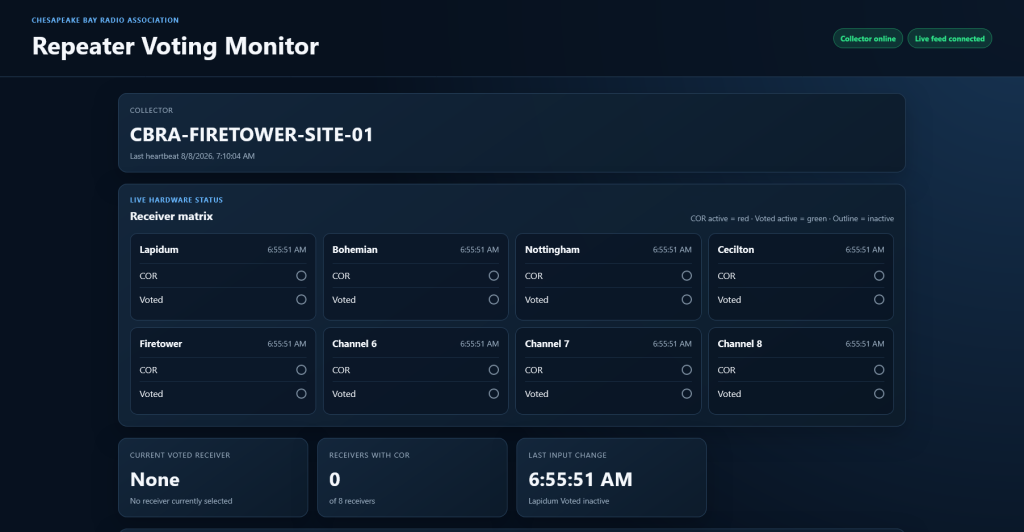
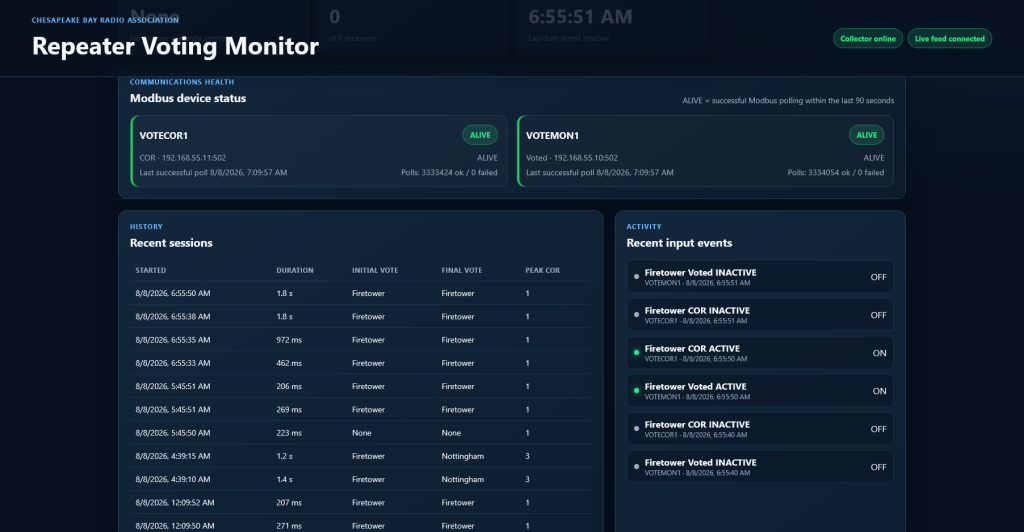
The core field interface and polling path have been proven through sustained test runs. The project creates a foundation for seeing which receiver is active, which receiver is being voted, whether the monitoring devices are healthy, and how the system behaves over time.
That foundation can support historical analysis, remote troubleshooting, maintenance records, dashboards, and notification workflows without exposing sensitive site-control functions publicly.
Why This Project Matters
Organizations often have reliable specialized equipment that predates modern APIs, cloud dashboards, and remote-management platforms. Replacing the equipment simply to gain visibility can be expensive and unnecessary. A carefully designed interface can extend the useful life of that infrastructure while providing the monitoring and operational context expected from a modern system.
The CBRA project demonstrates VSS experience across electronics, communications infrastructure, Ethernet I/O, Modbus, Windows services, logging, troubleshooting, and web-ready monitoring architecture.
Specialized Integration
Need visibility into equipment that was never designed for modern monitoring?
VSS Business Solutions connects hardware, communications systems, network I/O, software, logging, and web technologies into practical supported solutions.
Explore Specialized Integration